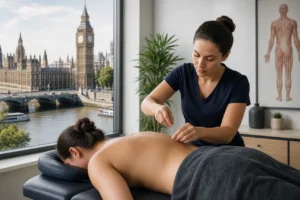
Your neck hurts, your shoulders are tight, and you’ve spent another day hunched over a screen. That’s tech neck, and it affects far more people than you’d think. Here are 10 expert-backed solutions, from hands-on osteopathy to home tools, so you can pick what works for your situation.
1. Laurens Holve Healthcare (Our Top Pick) , Expert Osteopathy for Tech Neck
nn
Laurens Holve Healthcare is a North London osteopathy practice with over 35 years of experience, offering a genuinely rare combination of osteopathy, acupuncture, and naturopathy under one roof. If your tech neck has gone beyond stiffness into persistent pain, headaches, or radiating arm discomfort, this is where to start.
nn
Most clinics in the area focus on a single modality. Woking practices tend to offer osteopathy alone, with only one adding occasional acupuncture. Laurens Holve Healthcare is the only clinic in this comparison that combines all three approaches, which matters for tech neck because the condition involves not just tight muscles but also inflammation, nerve irritation, and postural compensation patterns that run down into the mid-back.
nn
Osteopathy addresses the structural side: joint restrictions, muscle tension, and forward-head posture mechanics. Acupuncture targets inflammation and pain signals. Naturopathy supports recovery through lifestyle and nutrition guidance. You get a treatment plan built around your specific presentation, not a generic protocol.
nn
The practice is explicitly focused on individuals seeking non-surgical, full treatment for tech neck, which sets it apart from broader neck-pain clinics targeting desk workers generally. If you’re in North London and your symptoms have persisted for more than a few weeks, Laurens Holve Healthcare is the clearest first call. One honest caveat: this is a clinical service, not a quick fix. You’ll likely need multiple sessions, and the best results come from pairing treatment with the self-care habits covered in the rest of this list.
nn
2. Posture Reminder Apps, Digital Reminder for Better Alignment

A posture reminder app is a simple, low-cost first line of defence against tech neck for anyone who spends long hours at a screen. The core idea is straightforward: the app monitors how you hold your device or sit at your desk, then sends an alert when you drift into a forward-head position.
Apps in this category fall into three types. Reminder-based apps send timed nudges to check your alignment. AI-monitoring apps use your phone’s camera or motion sensors to detect slouching in real time. Exercise-focused apps guide you through stretches and strengthening routines you can do at your desk.
For most people, a reminder-based app is the right starting point. It builds the habit of noticing your posture before pain sets in. The key feature to look for is customisable alert frequency: you want nudges at intervals that match your work rhythm, not constant interruptions that you start ignoring after day two.
Apps that integrate with wearable devices tend to be more accurate than phone-only options, because they track movement across the whole day rather than just when you’re holding your phone. Progress tracking is also worth having. Seeing a weekly chart of how often you corrected your posture is a stronger motivator than a daily notification count.
The limitation here is real: no app fixes tech neck on its own. It raises awareness, which is genuinely useful, but awareness without the structural work underneath it only gets you so far. Use an app alongside the exercises and ergonomic adjustments further down this list.
Portable Strength Training Tools
Resistance bands are one of the most usable tools for addressing the muscular weakness that drives tech neck. The problem with forward-head posture isn’t just that you’re holding your head in the wrong position. It’s that the deep cervical flexors and scapular stabilisers have switched off, leaving the superficial neck muscles to do all the work.
A resistance band kit gives you the tools to rebuild that strength progressively. The chin-tuck with band resistance is the core exercise: you wrap the band around the back of your skull, let your head drift forward slightly, then pull back and tuck your chin against the band’s resistance. You’re strengthening the same muscles you were using before tech neck taught your body the wrong pattern.
Resistance bands are affordable and portable, and the tension increases as you stretch the band, which gives you natural variable resistance without needing a gym. A medium or heavy band is usually the right starting point for upper-body posture work, a light band won’t challenge the muscles enough to drive adaptation.
Pair the banded chin-tuck with scapular retractions (pulling your shoulder blades back and down) and you’re addressing both the neck and the mid-back compensation pattern. Three sets of 10 to 15 reps, a few times a week, is a realistic starting protocol.
The caveat: bands are a training tool, not a treatment. If you have acute neck pain or nerve symptoms like tingling down your arm, get assessed by a practitioner before loading the neck with resistance.
4. Ergonomic Office Chair, Office Seating Solution
An ergonomic chair addresses tech neck at the source: the hours you spend sitting. Most people focus on their neck position without realising that poor lumbar support pulls the whole spine into a slump, which then forces the head forward to compensate. Fix the base and the neck often follows.
The key setup points matter more than the chair brand. Your feet should be flat on the floor. Your knees should be level with or slightly lower than your hips. The chair back should support your lower back’s natural curve, not push your upper back forward. That last point catches people out: expensive executive chairs with thick padding often push the thoracic spine forward, making tech neck worse rather than better.
Armrests are worth getting right. They need to sit at a height that lets your elbows hang at 90 degrees while your shoulders stay relaxed. If the armrests are too high, your shoulders shrug all day. Too low and you lean to one side. Either way, the tension ends up in your neck.
A height-adjustable desk paired with a good chair gives you the most flexibility, because you can fine-tune the relative heights of your keyboard and screen independently. The screen’s top edge should sit at eye level. Looking down even a few degrees for hours at a time loads the neck far more than people expect. Research on office ergonomics confirms that workstation setup alone doesn’t prevent neck pain, but poor setup reliably causes it.
If you’ve already invested in a chair that pushes your upper back forward, a lumbar roll placed at the small of your back can shift your whole posture forward enough to make a real difference without replacing the chair.
5. Adjustable Phone Stand, Hands‑Free Device Positioning
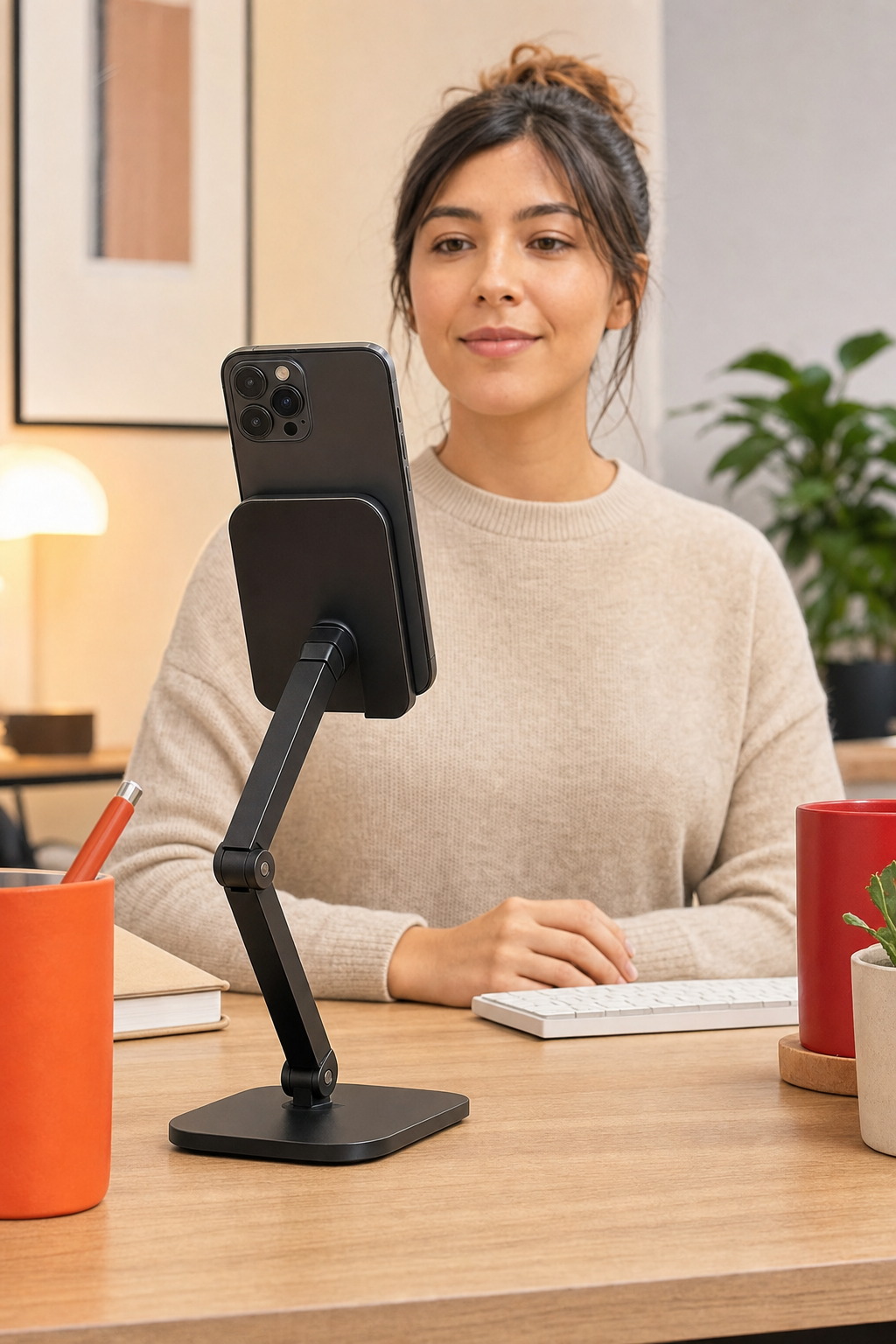
A phone stand is one of the cheapest and most direct interventions for tech neck. The problem with scrolling is mechanical: every degree your head tilts forward multiplies the effective weight your neck has to support. At 15 degrees of forward tilt, your neck is managing roughly three times its normal load. At 60 degrees, that figure climbs sharply. Raising your phone to eye level eliminates that load almost entirely.
A good adjustable phone stand lets you set the height and angle so the screen sits at or slightly below eye level, in front of your face rather than in your lap. This single change can dramatically reduce the cumulative strain on your cervical spine across a day of messaging, reading, and watching video.
The same principle applies to tablets. Propping a tablet flat on a table and looking down at it for an hour is one of the most reliable ways to aggravate tech neck. A stand that holds it upright changes the mechanics completely.
For desk use, a monitor arm or laptop stand serves the same function on a larger scale. The goal in every case is to bring the screen to your eyes rather than bringing your eyes to the screen.
One usable note: a phone stand doesn’t help if you then lean forward to see the screen more clearly. If you’re squinting, the text is too small, increase the font size rather than closing the distance.
6. Foam Roller, Myofascial Release Tool
A foam roller targets the thoracic spine, the segment of your back between your shoulder blades, which is often the stiffest part of the chain in people with tech neck. When the mid-back locks up, the neck compensates by taking on extra movement and load. Releasing thoracic stiffness takes pressure off the neck without touching it directly.
The basic technique involves placing the roller horizontally across your upper back, supporting your head with your hands, and gently extending over the roller segment by segment. You’re working on mobility, not cracking joints. Move slowly, pause where you feel resistance, and breathe through it.
Adult tummy time, highlighted in physical therapy video content as a complement to foam rolling, works on a similar principle. Lying face-down on a yoga mat with your elbows spread wide and pressing gently into the ground activates the deep stabilisers of the neck and upper back. Start with five minutes. It’s harder than it sounds if your postural muscles have been dormant for months.
Myofascial release with a roller is best used as a warm-up before strengthening exercises, not as a standalone fix. Loosening stiff tissue without then strengthening the muscles around it just returns you to the same position. Think of rolling as opening the door, and the resistance band work as walking through it.
Avoid rolling directly on the neck itself. The cervical spine is not designed to be loaded the way the thoracic spine is, and direct pressure on the neck vertebrae can cause more harm than good.
7. Guided Breathing for Neck Relief
Breathing and neck pain are more connected than most people realise. When you’re stressed or in pain, you tend to breathe with your chest and accessory muscles, including the scalenes and the sternocleidomastoid, which are also neck muscles. Recruiting them for breathing all day adds to the load on a neck that’s already under strain from forward-head posture.
Research has shown that breathing exercises can reduce pain and disability for people with persistent neck pain. The mechanism involves restoring diaphragmatic breathing, which takes the neck muscles out of their respiratory role and lets them focus on what they’re actually for: supporting and moving your head.
Diaphragmatic breathing, also called belly breathing, is the target. You breathe in so that your abdomen expands rather than your chest rising. This engages the diaphragm fully and reduces the demand on the neck’s accessory muscles. A guided breathing program cues you through this pattern with timed inhale and exhale prompts, which is useful when you’re learning the technique and your body keeps defaulting to chest breathing.
Box breathing (equal counts of inhale, hold, exhale, hold) and progressive muscle relaxation are two other approaches that pair well with neck pain management. Both reduce sympathetic nervous system activation, which tends to increase muscle tension and pain sensitivity.
Five to ten minutes of guided breathing once or twice a day is enough to shift the pattern over a few weeks. The limitation is that breathing retraining takes time. You won’t feel a dramatic difference after one session, but the cumulative effect on neck muscle tension is real.
8. Online Core & Posture Workout Programs
Tech neck is often described as a neck problem, but the neck is the end of the chain, not the start. Weak core muscles mean the spine can’t hold itself upright without effort, which means the neck and shoulders compensate to keep the head balanced. Strengthening the core changes what the neck has to do all day.
Pilates is well-suited to this because it emphasises the deep stabilisers, the transverse abdominis, the multifidus, and the pelvic floor, rather than the superficial muscles that most gym exercises target. These deep muscles are the ones that maintain posture passively, without you having to think about it.
An online Pilates program is accessible for people who can’t get to a studio, and the format works well for postural work because you can pause, rewind, and check your alignment in a mirror without the time pressure of a live class. Look for programs that include thoracic extension work and scapular stability alongside the core exercises. Those are the direct links to tech neck relief.
The neck flexor isometric, lying on your back with your chin tucked and your head held just off the floor, is a specific exercise that physical therapists recommend for tech neck. Research suggests that people without neck pain can hold this position for around 40 seconds. If you can’t get close to that, your deep neck flexors need work. A good Pilates program will build this capacity gradually.
Consistency matters more than intensity here. Three sessions a week of 20 to 30 minutes will produce more change than one long session on the weekend.
9. Heat Therapy Pack, Targeted Heat Therapy
Heat is the right choice for the kind of neck pain that tech neck usually produces: chronic stiffness, tight muscles, and tissue that’s been in a shortened position for too long. Heat improves circulation to the area, which delivers more oxygen and nutrients to the tissue and helps loosen the muscle fibres that have been holding tension all day.
A wearable USB‑powered neck heat wrap is usable for office use because you can keep it on while you work. Three heat settings let you adjust the intensity, and an auto‑off feature prevents overheating. The key instruction that’s easy to overlook: start with the lowest setting, especially if your skin is sensitive, and never apply heat directly to skin without a layer of fabric between them.
Heat works best for chronic, ongoing stiffness rather than a new acute injury. If you’ve just strained your neck or it’s visibly swollen, ice is the right call first. For the day‑to‑day tightness that builds up from hours at a screen, a 15 to 20 minute heat session in the evening is a straightforward way to ease tension before it compounds overnight.
You can read more about when to use heat versus cold for musculoskeletal injuries in our guide to the ice vs heat debate for pulled muscles, which covers the same principles in more depth.
Heat packs aren’t a treatment for the underlying cause of tech neck. They reduce symptoms and make it easier to do the exercises and stretches that actually change the pattern. Think of them as preparation and recovery, not the main event.
10. Cold Therapy Packs, Cold Therapy for Inflammation
Cold therapy does something different from heat, and knowing when to use it matters. Ice constricts blood vessels, slows circulation, and reduces swelling. It’s the right choice in the first 24 to 72 hours after an acute injury or during a flare‑up where the neck feels hot, swollen, or sharply painful rather than just stiff and achy.
Gel packs that can be chilled in the freezer are more usable than ice bags for neck use because they conform to the shape of the neck and stay cold for longer. Apply for 15 to 20 minutes at a time, always with a thin cloth between the pack and your skin to prevent ice burn. Repeat several times a day during an acute flare.
Some people find that alternating heat and cold, what clinicians call contrast therapy, works better than either alone for their particular pattern of neck pain. A common approach is ten minutes of cold followed by ten minutes of heat, repeated two or three times. It’s worth experimenting to find what your neck responds to best.
Clinical guidance recommends: ice for new or inflamed injuries, heat for chronic stiffness, and professional assessment if pain persists beyond a week of self‑care or if you develop numbness, tingling, or weakness in your arms. Those symptoms suggest nerve involvement that needs proper evaluation, not more home therapy.
Cold packs are an inexpensive, drug‑free option for managing flare‑ups while you work on the longer‑term solutions. They don’t fix the postural problem, but they can take the edge off enough to let you move and exercise without pain getting in the way.
Tech Neck Relief Options , Quick Comparison
Different people need different starting points. This table maps each option to the type of problem it addresses, who it suits best, and its main limitation, so you can build a plan rather than just picking one thing and hoping for the best.
The pattern you’ll notice: most of these options work best in combination. A device stand removes the daily load. Resistance bands rebuild strength. A posture reminder app keeps you honest between sessions. And when symptoms are persistent or severe, professional care at a practice like Laurens Holve Healthcare addresses what self-care can’t reach.
“The better our posture, the more upright our body is, the longer we’ll be able to stay upright and move pain-free.” , Physical therapist, Good Morning America
How to Choose the Right Tech Neck Relief Option
nn
Start with severity. If your neck pain is new and mild, a phone stand, posture app, and some resistance band exercises are a reasonable first response. If pain has been there for more than a few weeks, or if you’re getting headaches, shoulder tension, or any arm symptoms, professional assessment should come first, not last.
nn
- n
- Acute flare-up (under 72 hours):Cold therapy first, then rest, then gentle movement once inflammation settles.
- Chronic daily stiffness:Ergonomic setup, heat therapy, and a structured strengthening programme.
- Persistent pain or nerve symptoms:Book with a practitioner. Laurens Holve Healthcare in North London offers an integrated assessment that covers the structural, inflammatory, and lifestyle factors together.
- Prevention and maintenance:Phone stand, posture app, and regular Pilates or band work to keep the pattern from returning.
n
n
n
n
nn
One decision rule worth keeping: if you’ve been doing the right things for four to six weeks and symptoms aren’t improving, that’s a signal to get assessed rather than adding more self-care tools. More tools don’t substitute for a diagnosis.
nn
Frequently Asked Questions
nn
What exactly is tech neck and what causes it?
n
Tech neck is the neck pain, stiffness, and headaches that come from holding your head in a forward-tilted position while using phones, tablets, or computers. Tilting your head just 15 degrees forward roughly triples the load on your cervical spine. Over hours and years, this overworks the neck muscles, compresses the joints, and weakens the deep stabilisers that normally hold your head in a neutral position.
nn
Can tech neck be fixed without seeing a professional?
n
Mild tech neck often responds well to ergonomic changes, resistance band exercises, and posture habits. But if symptoms have lasted more than a few weeks, include headaches, or involve any tingling or numbness in your arms, you need a proper assessment. Self-care manages load and builds strength; it can’t diagnose or treat structural issues like joint restriction or nerve irritation.
nn
How long does it take to see improvement from tech neck exercises?
n
Most people notice some reduction in daily stiffness within two to four weeks of consistent exercise and ergonomic changes. Meaningful strength improvements in the deep neck flexors take six to eight weeks of regular training. If you’re not seeing any change after four to six weeks of doing the right things, that’s a prompt to get assessed rather than wait longer.
nn
Is heat or cold better for tech neck?
n
It depends on the type of pain. Cold therapy works best for acute flare-ups, new injuries, or inflammation in the first 72 hours. Heat is better for the chronic daily stiffness that most tech neck sufferers experience, because it loosens tight tissue and improves circulation. Some people do well alternating between the two. When in doubt, try heat first for ongoing stiffness and cold for anything sudden or swollen.
nn
What is adult tummy time and does it help with tech neck?
n
Adult tummy time means lying face-down on a mat and gently lifting your head and chest using your upper-back muscles, not your neck. It activates the deep stabilisers of the cervical and thoracic spine, the same muscles that forward-head posture switches off. Physical therapists recommend starting with five minutes a day on a soft surface. It’s a low-tech, no-cost exercise that directly addresses the muscular imbalance behind tech neck.
nn
When should I see a professional for tech neck?
n
See a professional if your pain has lasted more than a few weeks, if it’s getting worse rather than better, or if you have any symptoms beyond the neck itself such as headaches, shoulder pain, or tingling and weakness in your arms. These suggest the problem is more complex than postural muscle fatigue. Practices like Laurens Holve Healthcare in North London and Woking specialise in exactly this kind of assessment.
nn
Where to Start
nn
If your symptoms are mild, a phone stand, a posture app, and a resistance band programme are a solid starting point you can put in place today. If pain has been building for weeks or keeps coming back, the most useful thing you can do is book an assessment with a practitioner who can see the whole picture. We at Laurens Holve Healthcare work with people across North London and Woking who are dealing with exactly this, and we’re here to help you find a plan that fits your life.