Dry needling for sciatica is sometimes offered as an add-on to care, but evidence directly testing it for sciatica is scarce. Before considering it, check whether muscle tension may be relevant, ask what the evidence can and cannot tell you, and discuss safety with a UK clinician.
Table of Contents
- Step 1: Understand What Dry Needling Targets
- Step 2: Consider Whether Muscle Tension Could Be Relevant
- Step 3: Check the Evidence and Set Expectations
- Step 4: Review Safety and Share Relevant Health Information
- Step 5: Know What a Clinician-Led Session May Involve
- Step 6: Review Your Response and Plan the Next Step
- Frequently Asked Questions
- Conclusion
Step 1: Understand What Dry Needling Targets
Dry needling uses a thin, solid needle without injecting medicine. A clinician places it into selected muscle tissue, often at a tender or tight spot called a trigger point. The aim is to affect local muscle pain or sensitivity. It is different from acupuncture in its treatment rationale, though both use needles.
For leg pain described as sciatica, some clinicians propose targeting muscles around the hip and lower back. These may include the piriformis and other deep gluteal muscles, along with the lumbar paraspinals beside the spine. The idea is that muscle tension in these areas may contribute to symptoms felt in the leg. That theory does not mean a muscle is always causing your sciatica.
Needling should not be treated as a stand-alone answer to a nerve-related problem. A clinician needs to consider the full pattern of symptoms and whether the cause may involve an irritated nerve root. A plain-language explanation of trigger point therapy can help you understand the muscle-focused approach, but it cannot tell you what is causing your own symptoms.
Medical dry needling is used to treat tight muscles that may be contributing to sciatica pain as part of a multimodal treatment plan. The technique may be used alongside other care, rather than as a replacement for assessment or a wider plan.
Ask the clinician to explain the intended target in your case. If the answer is simply that a needle will treat the sciatic nerve, ask how they reached that view and what other causes they considered.
Key takeaway: Needling targets muscle tissue. It does not, by itself, identify the cause of pain travelling down your leg.
Step 2: Consider Whether Muscle Tension Could Be Relevant
Ask what makes a muscle contribution plausible in your case. A clinician may check whether pressure or movement around your hip or lower back brings on familiar discomfort. They may also ask which activities change your symptoms. Those findings can guide a discussion, but they do not prove that muscle tension is the source of sciatica.
Leg pain can have more than one explanation. Sciatica is commonly used to describe pain in the leg that may come from irritation of nerves travelling from the spine. Some people also have muscle tenderness or stiffness. Finding a tender spot does not rule out a nerve-related cause, and it should not replace a full assessment.
Before agreeing to needling, ask the clinician to set out the reason for choosing it over other options. A useful answer should link the proposed muscle target to your symptoms and explain how they will judge whether it is worth continuing. You can also ask what the plan would be if your leg symptoms do not change.
Think about a day-to-day example. If sitting brings on symptoms, tell the clinician how long you can sit and what happens when you stand. If walking is the main difficulty, describe when the pain starts and whether it changes as you move. These details help frame your goals without assuming that needling is the answer.
Muscle treatment may be considered as one part of care when a clinician thinks it could support movement or activity. The evidence for dry needling specifically in sciatica remains limited, so avoid treating a proposed muscle explanation as a confirmed diagnosis.
 Step 3: Check the Evidence and Set Expectations
Look for research on dry needling for sciatica itself, not just research on needling for other kinds of pain. Evidence for one body area or condition cannot automatically be applied to another. No clinical studies evaluating dry needling for sciatica were found, so direct evidence of its effectiveness is not available.
Sciatica can involve neuropathic pain. A scoping review found that neuropathic pain mechanisms are not routinely considered in needling approaches for people with sciatica.
The research findings identified no clinical studies evaluating dry needling for sciatica. There is no direct clinical evidence available to show how well it works for sciatica.
Be cautious with precise claims about how quickly symptoms should change or how many sessions you will need. Published descriptions of treatment plans are not the same as reliable evidence that a set number of appointments works.
Ask the clinician to describe the intended goal in terms you can track. For example, you might agree to note whether a particular activity feels easier, stays the same, or becomes harder. A change after treatment does not, by itself, prove what caused it. Symptoms can vary over time, and people respond differently.
Laurens Holve Healthcare is an osteopathy practice with locations in North London and Woking. If you discuss needling there, ask how it would fit alongside an assessment and any other care being considered. The choice should follow a conversation about the uncertainty, not a promise of a particular result.
Pro tip: Ask, “What would count as a useful change for me, and when will we review whether this approach still makes sense?”
Step 4: Review Safety and Share Relevant Health Information
Tell the clinician about your health and any medicines before a needling session. This gives them a chance to decide whether the technique is suitable, needs extra care, or should be avoided. Be clear about any medicine that affects blood clotting, a bleeding condition, a current infection near the area, or a strong fear of needles.
Also mention pregnancy, allergies, immune or skin problems, recent surgery, and any change in your symptoms. This list is not a diagnosis or a complete set of exclusions. The clinician should ask questions that fit your situation and explain what they plan to do before treatment starts.
Needling can cause short-term soreness or bleeding at the site. Bruising may occur. Research on adverse events has also reported less common problems, including nerve irritation or injury, and rare reports of infection or pneumothorax. The chance and type of risk depend in part on the area treated and the technique used.
Ask how the clinician keeps the procedure clean, what area they plan to treat, and what sensations you may notice. You can ask them to pause at any time. Consent is an ongoing choice, not a one-off form. If you feel unsure, you can take time to think or ask your GP for advice.
Tell the clinician about new weakness, numbness, or a change in bladder or bowel function. These symptoms may need medical assessment rather than a routine treatment appointment. If you have sudden loss of bladder or bowel control, numbness around the genitals or anus, or rapidly worsening weakness, seek emergency medical care now.
Do not stop prescribed medicine or postpone a GP assessment because you are considering needling. It is reasonable to discuss the option while keeping your usual medical care in place.
Step 5: Know What a Clinician-Led Session May Involve
A session should begin with questions and an assessment, not an automatic choice of needle placement. The clinician may ask where you feel pain, how it travels, what affects it, and how it changes your daily activities. They may examine movement and strength, then explain what they think the findings mean.
Before treatment, expect a clear discussion of the proposed area, the reason for choosing it, possible side effects, and alternatives. Ask whether needling is being considered as an add-on or as the main treatment. For sciatica, dry needling is an adjunct, not a primary treatment.
If you want to know how Laurens Holve Healthcare describes the technique, its page on dry needling services and clinic locations gives practice information. Use that alongside an individual assessment. A service description cannot show whether the approach fits your symptoms.
During the procedure, the clinician should explain what they are doing and check that you are comfortable to continue. You may feel a brief prick or an ache, but there is no single sensation that proves the treatment is working. Tell them if you feel sharp pain, distress, or anything that concerns you.
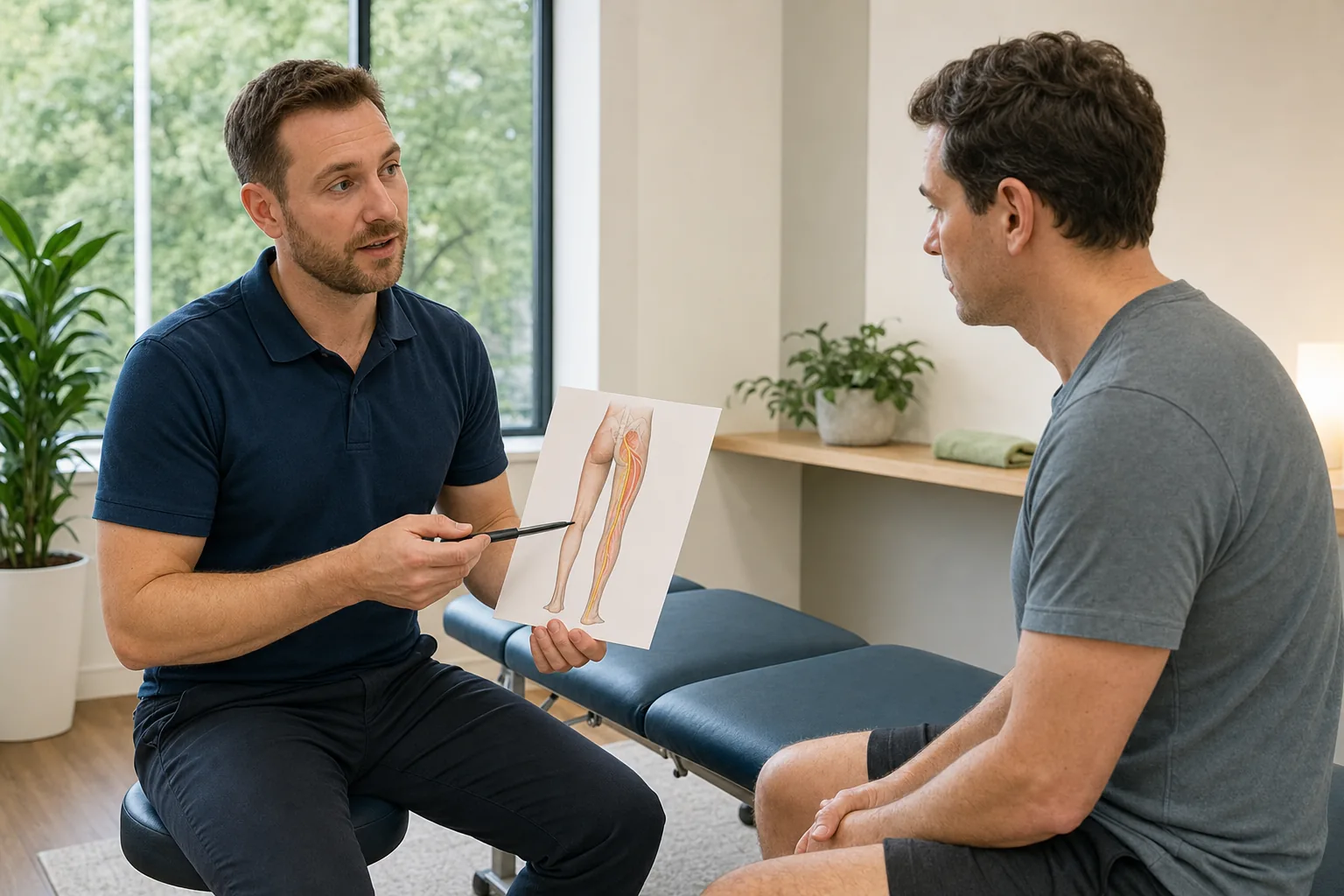 Afterwards, ask what to expect and what to do if symptoms change. The answer should be specific to your assessment. You should also know who to contact for medical advice if you notice a concerning change, rather than relying on the needling clinician to rule out every possible cause.
A clinician may suggest activity or movement as part of a wider plan. Ask how that advice relates to your symptoms and whether you should change anything you already do. Avoid making a major change to prescribed care without discussing it with the health professional responsible for that care.
Step 6: Review Your Response and Plan the Next Step
After the session, note what changed and when. Keep it simple: record a daily activity that matters to you, how it felt before treatment, and whether it feels different afterwards. Include any soreness or other effects. A brief note can make the next discussion clearer than relying on memory.
Do not judge the result by one moment alone. Sciatica symptoms can vary, and a short-term change does not establish that needling caused it. The key question is whether the care plan still fits your symptoms and priorities when you review it with the clinician.
Further sciatica information. If your symptoms worsen or do not improve, speak with a healthcare professional rather than assuming another needling session is the right next step.
Agree on a review point before continuing. Ask what would lead the clinician to change the plan, stop needling, or suggest medical assessment. If you are not seeing a useful change in the activity you chose to track, that is a reason to revisit the plan, not to assume you need more sessions.
If you want to discuss sciatica care with Laurens Holve Healthcare, its information about sciatica assessment describes its osteopathy service in North London and Woking. An assessment can help you discuss whether an option suits your situation; it cannot guarantee a result.
Seek urgent medical help for new problems controlling your bladder or bowel, numbness around the saddle area, or severe or quickly worsening weakness. For other new or persistent symptoms, contact your GP or another appropriate healthcare professional for advice.
Frequently Asked Questions
Can dry needling help sciatica?
It is not known whether dry needling helps sciatica because direct clinical evidence is lacking. A scoping review found no studies testing dry needling for sciatica among the papers it included. Some clinicians may consider it as an add-on when muscle tension seems relevant, but that is not proof it will help your symptoms.
Is dry needling available on the NHS?
Access can depend on the service and area, so ask your GP or local NHS musculoskeletal service what is available to you. Do not assume that private availability means the NHS provides the same treatment. If you are considering private care, discuss the evidence and your medical history with the clinician first.
How many dry needling sessions are needed for sciatica?
There is no established session count for dry needling and sciatica. Published treatment descriptions do not provide a reliable standard that applies to everyone. Ask what change the clinician expects to review, when they will review it, and what would lead them to stop or alter the plan.
Is dry needling the same as acupuncture?
No. Both use solid needles, but dry needling is generally described as targeting muscle tissue or trigger points. Acupuncture has a different treatment rationale. If you are unsure which treatment is being discussed, ask the clinician to explain the method, the intended target, and why they think it may suit your symptoms.
When should I seek urgent help for sciatica?
Seek emergency medical care for new loss of bladder or bowel control, numbness around the genitals or anus, or rapidly worsening weakness. These symptoms need urgent assessment. For new or ongoing leg pain without those signs, contact your GP or another healthcare professional for advice, especially if symptoms worsen or affect daily life.
Conclusion
Treat dry needling as an optional add-on with uncertain direct evidence for sciatica, not as a substitute for assessment or medical care. Before proceeding, ask a clinician to explain the target, risks, and review plan. If you have new or persistent symptoms, arrange an assessment with an appropriate UK healthcare professional.