Back pain doesn’t care about your schedule. Whether it flares up on a Monday morning or slowly grinds you down over months, finding the right osteopath in North London can make all the difference. Here are the top options, ranked by what they actually offer, starting with our top pick.
1. Laurens Holve Healthcare — Our Top Pick for Back Pain in North London
Laurens Holve Healthcare is our first choice, and it’s not a close call. Laurens has been in private practice since 1984, bringing over 40 years of hands-on experience treating acute and chronic back pain at clinics in Highgate, North London, and Woking.
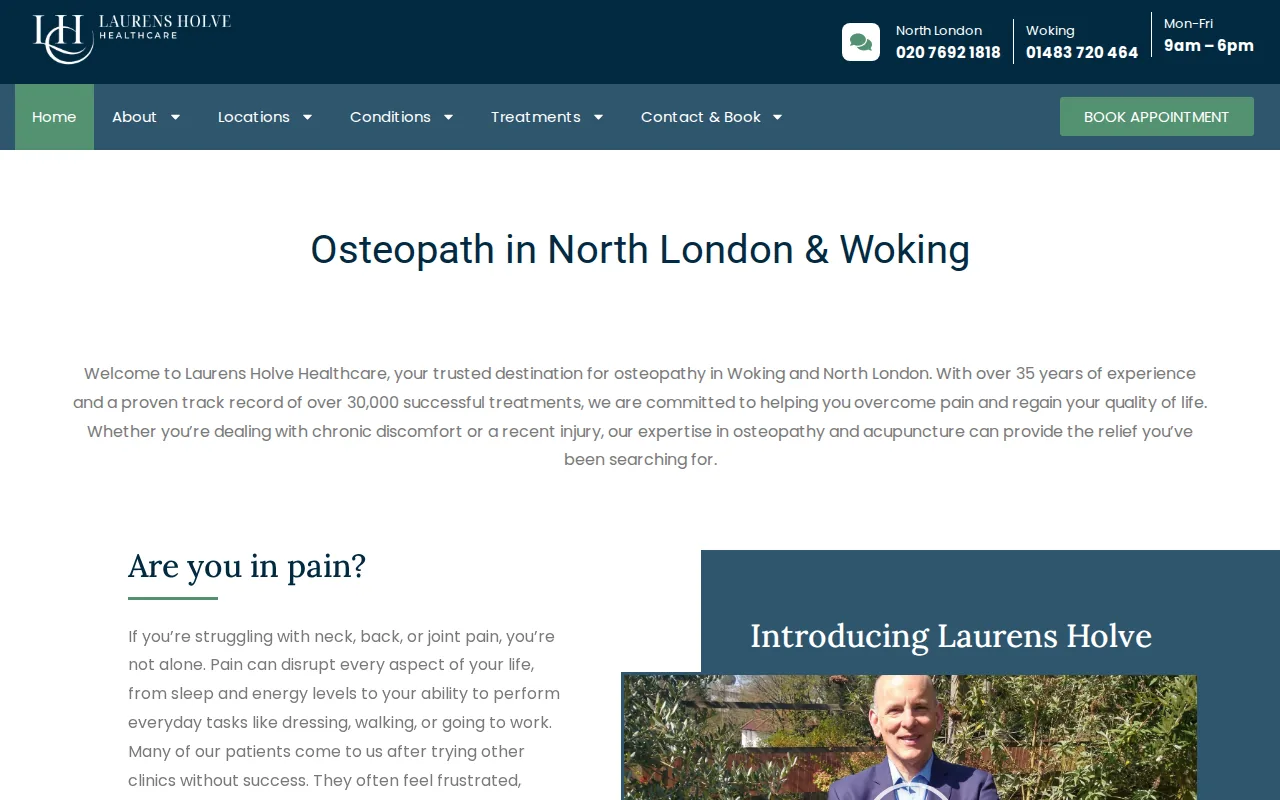
The practice combines osteopathy, acupuncture, and naturopathy under one roof. That matters for back pain because muscle tightness, joint restriction, and nerve irritation rarely travel alone. Being able to combine spinal manipulation with dry needling or acupuncture in the same session means treatment adapts to what your body actually needs that day, rather than a fixed protocol.
Laurens is registered with the relevant statutory regulatory body for osteopaths practising in the UK. The back pain clinic at Laurens Holve Healthcare uses joint mobilisation, soft-tissue work, myofascial release, and trigger point therapy to improve spinal alignment and reduce pain. First-contact assessment and same-session treatment are standard, so you’re not waiting two visits just to be touched.
One honest caveat: appointment slots at Highgate book up quickly. If you need something this week, check both the North London and Woking diary.
2. Specialist Disc & Spinal Decompression Clinics — For Disc-Related Back Pain
If your back pain comes with sciatica, radiating leg pain, or an MRI showing bulging discs at L4/L5, a general osteopathy appointment may not be enough on its own. This is where clinics offering spinal decompression therapy fill a specific gap.
Spinal decompression therapy uses a computerised machine to apply a precisely targeted, oscillating traction force to a specific spinal segment. It’s not the same as old-fashioned traction. The machine targets the exact disc level shown on your scan, which is something manual therapy alone can’t replicate. The approach works directly on the disc space itself, bridging the gap between conservative care and spinal injections.
Some clinics in North London offer this approach alongside osteopathic treatment. Non-surgical spinal decompression sits within the category of manual therapies recommended before considering more invasive routes, making it a recognised option for disc-related conditions such as bulging or herniated discs.
If you’ve already tried standard osteopathy for a disc problem without lasting improvement, adding spinal decompression to your treatment plan is worth exploring with your practitioner.
3. Integrative Osteopathy Practices — Combining Acupuncture & Naturopathy
Some back pain doesn’t respond to manual therapy alone. Chronic low-grade pain, pain linked to stress or poor sleep, or pain that keeps returning every few months often has layers that joint mobilisation can’t fully reach.
Integrative practices bring acupuncture and naturopathy alongside osteopathy. Acupuncture targets pain at the neurological level, stimulating the nervous system to reduce the sensitivity of pain receptors and relax the muscles around the affected spinal segment. Naturopathy looks at lifestyle factors, including diet, stress, and sleep, that keep pain cycles running.
Laurens Holve Healthcare is a natural example of this model. The acupuncture treatment available at the North London and Woking clinics runs alongside osteopathic sessions, and both modalities are applied by the same experienced practitioner who understands how they interact. That continuity is valuable. You’re not translating your history between different specialists each visit.
For patients who’ve spent years cycling through short-term relief, an integrative approach that treats the whole picture is often what finally breaks the pattern. Ask any clinic you’re considering whether they can combine modalities in a single session, or whether the treatments are siloed across different practitioners.
4. Registered Solo Practitioners — Personalised One-to-One Care
All osteopaths practising in the UK must be registered with the relevant regulatory body. This is a legal requirement, not a voluntary badge. Registration means the practitioner has completed a four or five-year degree-level programme in osteopathy, holds professional indemnity insurance, and engages in ongoing continuing professional development.
Solo practitioners who run their own one-room practice often offer something the larger multi-bed clinics don’t: you see the same person every time, and your treatment isn’t handed off to whoever is free. For back pain, that continuity matters. Your osteopath already knows how you moved three sessions ago and can track whether the sacroiliac restriction that was dominant last month has resolved or shifted.
When looking at solo practitioners in North London, check the official osteopathic register directly before booking. The register is free to search online and confirms current registration status. Also ask how many sessions they’d typically recommend for your type of presentation and whether they offer a free initial phone consultation. A practitioner who won’t discuss your case before charging a full assessment fee is a yellow flag.
Solo practice is a good fit if consistency and a slower, more investigative approach to your pain matters more to you than clinic facilities or same-week availability.
5. Sports & Musculoskeletal Osteopathy Clinics — Active Patients & Athletes
Back pain in runners, cyclists, gym-goers, and weekend sport players has a different character than desk-worker back pain. The loading patterns, the movement faults, and the recovery demands are all different. A clinic with a sports and musculoskeletal focus will assess you moving, not just lying on a table.
Sports osteopaths typically look at how you squat, how you hinge, and how load transfers through your pelvis and spine under real conditions. They’ll test hip mobility and single-leg stability because those almost always contribute to lower back problems in active people. Treatment is faster-paced, more functional, and often includes exercise prescription from session one rather than purely passive hands-on work.
In North London, look for practitioners who specifically mention musculoskeletal (MSK) assessment or sports injury experience on their GOsC profile or clinic website. Ask whether they work with athletes regularly and whether your treatment plan will include returning you to sport rather than just reducing pain in rest.
If you’re training through back pain or trying to return after an injury, a sports-focused osteopath is a better match than a general practice, even if both practitioners hold the same qualification.
6. Private Multi-Disciplinary Clinics — Osteopathy Alongside Massage & Rehabilitation
Multi-disciplinary private clinics bring several practitioners under one roof: osteopaths, remedial massage therapists, and rehabilitation specialists. For complex or persistent back pain, having all three working from the same assessment notes saves a lot of time and reduces the risk of conflicting advice.
The usable advantage is sequencing. A massage therapist can work on chronically tight thoracolumbar fascia before your osteopath session, so the joints move more freely during manipulation. A rehabilitation specialist can design a progressive loading programme to follow your osteopathic treatment plan. That kind of coordination is harder to achieve when each practitioner is at a separate practice.
When assessing a multi-disciplinary clinic, ask how communication works between practitioners. Do they share notes? Is there a lead practitioner coordinating your care? A clinic where each therapist operates independently despite being in the same building offers less than it appears. The coordination is the point.
7. NHS-Linked & Woking-Based Osteopaths — Local Access Beyond North London
Osteopathy sits within the NHS as an Allied Health profession. Some osteopaths work as First Contact Practitioners (FCPs) in GP surgeries, meaning patients can be referred directly without a GP appointment first. If you’re on the NHS waiting list for a musculoskeletal referral, asking your GP whether their surgery has an FCP osteopath can shorten the timeline significantly.
For those outside central North London, Woking offers a good alternative. Laurens Holve Healthcare runs a clinic in Woking alongside the Highgate practice, with the same clinical approach at both locations. If traffic or commute time into North London puts you off, the Woking clinic covers the same conditions, uses the same treatment range, and has the same 40-plus years of clinical experience behind it. The osteopathy service is available for booking at both locations online.
For patients using private medical insurance, check with your insurer before booking. Laurens Holve Healthcare is on the lists of major medical insurers, though what’s covered varies by policy and whether you have an excess to meet.
8. Osteopaths Offering Home-Exercise Programmes — Post-Treatment Self-Care
The treatment session is one hour. The other 167 hours of the week are yours. What you do in those hours directly affects how fast you get better and whether the improvement lasts.
Good osteopaths don’t just treat and discharge. They give you specific exercises matched to your presentation. For lower back pain, that might mean hip flexor stretching, gluteal activation, or gentle spinal mobilisation in the morning. The exercises keep the joints moving between sessions and prevent the muscles from tightening back to where they were.
Ask any osteopath you’re considering whether they provide a written home programme. A verbal “do some stretching” at the end of a session is not enough. You want a specific set of movements with clear instructions on how often and how many repetitions, adjusted as your condition changes. Practitioners who treat this as a core part of their service rather than an afterthought tend to produce better long-term outcomes.
9. Evidence-Based Osteopathy Practices — Clinics Grounded in Research
Clinical guidance in the UK recommends both osteopathy and acupuncture in the management of low back pain. That’s a meaningful benchmark. It means the evidence base is strong enough that the UK’s primary clinical guidance body endorses these treatments as part of a care pathway.
Evidence-based clinics stay current with that guidance. They don’t oversell outcomes (“we’ll fix your back in three sessions”) and they’re transparent about what osteopathy can and can’t do. They’ll tell you that for acute lower back pain relief typically comes within two to three sessions, but chronic or long-standing pain takes longer and may need maintenance visits every few months.
Signs of an evidence-based practice: they document your pain scores at each visit, they adjust the treatment plan if you’re not progressing, and they refer you to a GP or specialist if red-flag symptoms appear. They also won’t keep you coming indefinitely if you’ve plateaued. Honest discharge or step-down to occasional maintenance is a mark of clinical confidence, not a failure.
10. Clinics Experienced in Red-Flag Screening — When to Refer On
Not all back pain is musculoskeletal. Some presentations require medical investigation before, or instead of, osteopathic treatment. Red flags include back pain that’s constant and doesn’t ease with rest, unexplained weight loss alongside back pain, bilateral leg weakness, or bowel and bladder changes. These symptoms need urgent medical review.
A competent osteopath screens for these at the first appointment. They take a full case history, ask about night pain and systemic symptoms, and perform orthopaedic tests to rule out serious pathology. If they identify anything concerning, they refer to a GP or A&E rather than treating through it.
This is a non-negotiable quality marker. Any clinic that skips a thorough first-session history and jumps straight to treatment is cutting corners that matter. Ask before you book: “Do you screen for red flags at the initial assessment?” The answer should be yes, without hesitation.
What to Look for When Choosing an Osteopath for Back Pain
Osteopath vs Chiropractor for Back Pain — Key Differences
This question comes up constantly in any back pain consultation. Here’s the honest distinction. Chiropractors focus on the spine as the root of dysfunction, working from the idea that spinal joint problems affect nerve signals to the rest of the body. Their assessment often includes imaging in the first visit, and treatment tends to be shorter sessions focused on spinal adjustments.
Osteopaths look more broadly. They assess the whole body for how compensatory patterns develop: a knee problem changes your gait, which shifts load to the hip, which tightens the lower back, which can eventually cause neck tension. The approach is wider, the sessions are longer, and there’s typically more soft-tissue work done before any joint adjustment.
For most back pain, the clinical evidence doesn’t strongly favour one over the other. What matters more is finding a practitioner you trust and feel comfortable with. That said, if your pain has a confirmed disc component, an osteopath with access to specialised disc decompression equipment offers something a chiropractor typically doesn’t.
FAQ
How many osteopathy sessions will I need for back pain?
For acute back pain, most people notice real improvement within two to three sessions. Chronic or long-standing pain takes longer, often six or more sessions, with occasional maintenance visits every few months after that. There’s no fixed rule: your osteopath should reassess your progress at each visit and adjust the plan accordingly. If you’re not improving after four or five sessions, that conversation should happen.
Is an osteopath or a GP better for back pain?
For mechanical back pain without red-flag symptoms, an osteopath can treat you directly without a GP referral. Osteopaths are trained First Contact Practitioners who assess, treat, and refer on when needed. A GP is the right first call if you have nerve symptoms, unexplained weight loss alongside pain, or bowel and bladder changes. For straightforward musculoskeletal back pain, booking an osteopath directly saves time.
What happens in a first osteopathy appointment for back pain?
Your osteopath will take a full case history, ask about the pain’s character, onset, and what makes it better or worse. They’ll watch you move, perform orthopaedic tests with their hands, and screen for red-flag symptoms. Then, in most cases, they’ll treat you in that same session. You’ll usually leave with advice on what to do and avoid before the next appointment.
Does osteopathy work for a slipped or bulging disc?
Osteopathy can help with disc-related back pain by reducing the muscle spasm and joint stiffness that surround an irritated disc. For more severe disc problems with sciatica or significant nerve compression, some clinics combine manual osteopathy with IDD spinal decompression therapy, which targets the specific disc level directly. An MRI scan result helps your osteopath decide which approach is appropriate for your presentation.
Is osteopathy safe for back pain?
Yes, for the vast majority of back pain presentations. Osteopaths are trained to screen for conditions where manipulation would be inappropriate, such as osteoporosis, recent fracture, or vascular problems. Minor soreness for 24 to 48 hours after treatment is normal, especially after the first session. Serious adverse events are very rare and are minimised by thorough first-session assessment. Always tell your osteopath about any existing medical conditions before treatment begins.
Do I need a GP referral to see an osteopath in North London?
No. Osteopaths are primary care practitioners, so you can book directly without seeing your GP first. Some patients are referred by their GP, but self-referral is normal and often faster. If you’re using private medical insurance, check your policy terms before booking, as some insurers require a GP referral letter to validate the claim.
Conclusion
If you’re dealing with back pain in North London and want treatment that looks at the whole picture rather than just the painful spot, Laurens Holve Healthcare in Highgate is the strongest starting point. With over four decades of clinical experience, GOsC registration, and the ability to combine osteopathy with acupuncture in a single session, it covers more ground than most. You can also find guidance on the best exercises for lower back pain on their blog if you want to start self-managing while you wait for your first appointment. Book a free 15-minute phone consultation to talk through your symptoms before committing to a full session.