That tight, pressing pain that starts at the base of your skull and creeps forward over your head? It’s not random. It comes from your neck. Muscle tension in the cervical spine is one of the most common, and most overlooked, drivers of recurring headaches, and understanding what’s actually going on is the first step toward getting real relief.
Table of Contents
- Understanding the Link Between Neck Tension and Headaches
- How Osteopathy Treats Neck‑Tension Headaches
- What to Expect During a Treatment Session
- Comparing Local Osteopathy Providers for Neck‑Tension Headaches
- Self‑Care Strategies to Complement Osteopathic Treatment
- FAQ
- Conclusion
Understanding the Link Between Neck Tension and Headaches
Tension headaches are the most common headache type in adults. The pain typically feels like a tight band pressing around the head, often dull rather than throbbing, and it can last anywhere from 30 minutes to several days. According to the World Health Organization, headache disorders are among the most widespread neurological conditions globally, with tension-type headaches affecting a large proportion of the adult population.
So what does your neck have to do with it? Quite a lot. The muscles running along the back of your neck and across your shoulders, particularly the trapezius and suboccipital muscles, attach close to the base of the skull. When these muscles tighten and stay tight, they pull on the surrounding connective tissue and compress small nerves in that region. That compression sends pain signals upward into the scalp, temples, and forehead.
There’s also the matter of trigger points. These are small, hyper-irritable knots within a muscle that, when pressed, refer pain somewhere else entirely. A trigger point in the upper trapezius, for example, can send pain up the side of the neck and into the temple. As our own guide on trigger point headaches explains, these knots are a frequent and underappreciated cause of head pain that feels completely disconnected from the neck.
What causes the muscles to tighten in the first place? Several things. Sitting at a desk with your head pushed forward puts enormous load on the cervical muscles. Stress causes you to unconsciously hike your shoulders. Poor sleep posture, especially with the neck bent at an awkward angle, can leave the muscles locked in a shortened position overnight. Even cold air on the back of the neck can trigger a contraction response in susceptible people.
The pain pattern matters too. A headache from neck tension typically starts at the back of the head and radiates forward. It’s usually bilateral, meaning both sides of the head, though it can favor one side. It doesn’t pulse the way a migraine does. There’s no nausea, no light sensitivity in most cases, and it often gets worse as the day goes on rather than appearing suddenly.
Key Takeaway: Neck tension headaches originate from tight muscles and trigger points in the cervical region, not from the head itself, which is why treating the neck directly tends to work better than painkillers alone.
Understanding this connection is important because it changes how you approach treatment. Masking the pain with over-the-counter medication may bring short-term relief, but if the underlying muscle tension isn’t addressed, the headaches keep coming back. That’s where osteopathy becomes genuinely useful.
How Osteopathy Treats Neck‑Tension Headaches
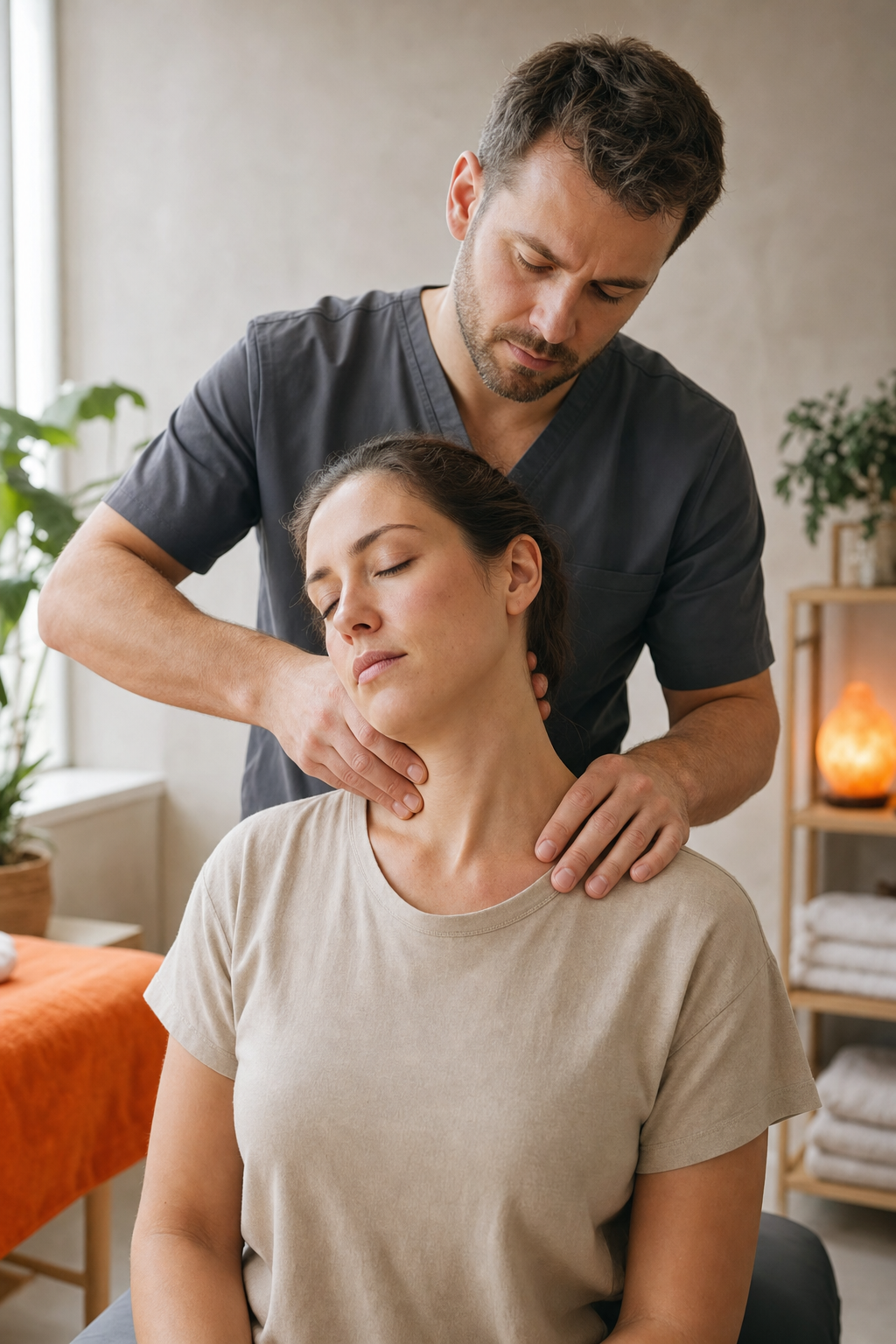 Osteopathy takes a hands‑on, structural approach to the body. Rather than treating symptoms in isolation, an osteopath looks at how the whole musculoskeletal system is functioning and finds where restrictions, imbalances, or tension patterns are creating problems. For headaches rooted in neck tension, this is a particularly good fit.
The core of osteopathic treatment for neck‑tension headaches involves soft tissue work on the muscles of the neck and shoulders. The osteopath uses slow, deliberate pressure to release tight muscle fibers, improve blood flow to the area, and reduce the neural irritation that’s driving referred pain into the head. This isn’t a rough manipulation. It’s controlled, specific, and adapted to what each patient’s body actually needs.
Joint mobilisation is often part of the picture too. The cervical spine is made up of seven vertebrae, and when any of these joints lose their normal range of movement, the surrounding muscles compensate by working harder. That extra effort creates fatigue and tension. Gently restoring movement to stiff joints takes pressure off the muscles and breaks the cycle.
At Laurens Holve Healthcare, the approach goes further than osteopathy alone. The clinic combines osteopathy with Acupuncture and naturopathy, a three-modality model that’s genuinely uncommon in North London and Woking. Acupuncture, for instance, is effective at calming overactive muscle tissue and reducing the neurological sensitivity that makes tension headaches so persistent. Naturopathic input can address contributing factors like inflammation, sleep quality, and stress, things that purely structural treatment doesn’t touch.
This matters because tension headaches rarely have a single cause. A patient who sits at a computer all day, sleeps poorly, and carries high levels of stress is dealing with three separate drivers of neck tension simultaneously. Treating only the muscles addresses one of them. A genuinely integrated approach works on all three.
Research published in peer-reviewed literature supports manual therapy for tension‑type headaches. Manual therapy directed at the cervical and upper thoracic spine has been shown to reduce both the frequency and intensity of tension‑type headaches, with effects sustained at follow‑up. Osteopathic treatment works along the same principles.
Pro Tip: If your headaches consistently start at the base of the skull and spread forward, tell your osteopath exactly that. That pattern points directly to the suboccipital muscles, and a practitioner who knows this can target treatment more precisely from the first session.
What to Expect During a Treatment Session
Your first appointment at an osteopathy clinic will typically begin with a detailed case history. The osteopath will ask about when your headaches started, how often they occur, where the pain is located, and what makes them better or worse. They’ll also ask about your daily routine, work setup, sleep habits, and any recent physical or emotional stress. This isn’t small talk. It’s diagnostic.
Next comes a physical assessment. The osteopath will observe your posture, check the range of motion in your neck and upper back, and feel the muscles and joints for areas of tightness or restriction. They’re looking for the specific pattern that’s driving your headaches, not just treating a generic complaint.
Treatment usually follows in the same session. For neck‑tension headaches, you can expect some or all of the following, depending on what the assessment reveals.
- Soft tissue massage and gentle techniques targeting the trapezius, sternocleidomastoid, and suboccipital muscles
- Gentle cervical joint mobilisation to restore normal movement
- Trigger point treatment, which may involve sustained pressure or dry needling
- Cranial techniques may be used if appropriate
- Acupuncture as part of an integrated session, where the clinic offers it
Most people feel some relief after the first session, though a single treatment rarely resolves a long‑standing pattern. A typical course of treatment for chronic tension headaches runs three to six sessions, spaced one to two weeks apart. The osteopath will reassess at each visit and adjust the approach as the tissue responds.
You might feel a little tender in the treated areas for a day or two afterward. That’s normal. The muscles have been worked, and some post‑treatment soreness is part of the process. Drink plenty of water and avoid anything that you know triggers your headaches in the days following a session.
One thing worth knowing: a good osteopath will also give you homework. Specific stretches, postural adjustments, or breathing exercises that support the work done in the clinic. Treatment that ends at the clinic door tends to produce slower results than treatment paired with what you do between sessions.
A few things stand out from this comparison. Most clinics in the area offer one or two treatment modalities. Laurens Holve Healthcare is the only practice in this dataset that combines osteopathy, acupuncture, and naturopathy under one roof, and it’s also the only one that explicitly defines its ideal patient rather than listing a broad range of conditions. That specificity matters if your primary concern is recurring headaches from neck tension, because it means the treatment approach is actually designed around your problem.
Geography is a usable factor. If you’re in Woking, the choice narrows considerably. If you’re in North London, you have more options. Laurens Holve Healthcare spans both areas, which is genuinely uncommon and useful if your schedule or location changes.
Self‑Care Strategies to Complement Osteopathic Treatment
 Osteopathic treatment works best when it’s supported by what you do day‑to‑day. The muscles in your neck don’t tighten once and then stay fixed. They respond continuously to how you sit, move, breathe, and manage stress. Building a few targeted habits into your routine can significantly reduce how often headaches appear and how severe they are when they do.
Posture at your workstation
Screen height is one of the biggest contributors to neck tension. If your monitor is too low, your head tilts forward and down for hours at a time. That position puts roughly three to four times the load on the cervical muscles compared to a neutral head position. Raise your screen so the top of the monitor sits at eye level. Your ears should sit directly over your shoulders, not in front of them. Our workstation ergonomics guide walks through exactly how to set this up.
Stretching the right muscles
The suboccipital muscles at the base of the skull and the upper trapezius are the two most common sources of tension that feeds headaches. Both respond well to gentle, sustained stretching. For the upper trapezius, tilt your ear toward your shoulder and hold for 30 seconds. Don’t force it. For the suboccipitals, tuck your chin gently toward your chest and hold. Do these three to five times per day, especially if you’ve been sitting for a long stretch.
The key word is sustained. A quick two‑second stretch does almost nothing for a chronically tight muscle. The muscle needs time under gentle tension to actually lengthen. Thirty seconds is a minimum. Sixty is better.
Heat and cold
A warm pack applied to the back of the neck for 15 to 20 minutes can reduce muscle tension and improve local circulation. This works well as a preventive measure at the end of a long day at a desk. Cold is more useful once a headache has already started, particularly if there’s any inflammation involved. Alternate between the two if you’re unsure which helps more, and pay attention to what your body tells you.
Breathing and stress response
Stress is a direct trigger for neck muscle contraction. When you’re anxious or under pressure, your shoulders rise, your breathing becomes shallow, and the muscles along the back of your neck shorten. Slow diaphragmatic breathing, where the belly expands on the inhale rather than the chest, activates the parasympathetic nervous system and starts to undo that tension response. Even five minutes of this, twice a day, makes a measurable difference over time.
Sleep position
Sleeping on your stomach forces your neck into rotation for hours. That’s enough to trigger a tension headache by morning. Back or side sleeping with a pillow that keeps the cervical spine in a neutral position is far better. If you wake up with a headache most days, your sleep position is worth examining before anything else.
“Tight muscles surrounding the neck press on nerves that refer pain to another location, in this case, the head. Poor posture can play a role as prolonged poor positioning can alter mechanics and cause muscular imbalances.”
These strategies don’t replace professional treatment, but they do extend its effects. Patients who actively manage their posture and stress between sessions tend to see faster improvement and longer‑lasting results than those who rely on clinic visits alone.
FAQ
Can neck tension actually cause headaches, or is it just a coincidence?
Neck tension is a direct cause of headaches, not a coincidence. Tight muscles in the cervical region compress nerves and refer pain upward into the scalp, temples, and forehead. Trigger points in the trapezius and suboccipital muscles are particularly well‑documented sources of referred head pain. Treating the neck directly, rather than just the headache, is why osteopathic and manual therapy approaches tend to produce lasting results.
How is a neck‑tension headache different from a migraine?
A tension headache from neck tightness typically feels like a dull, pressing band around the head, starting at the back and moving forward. It doesn’t pulse, and it rarely causes nausea or light sensitivity. A migraine is usually one‑sided, throbbing, and often accompanied by nausea, visual disturbance, or sensitivity to light and sound. That said, migraines can also be triggered by neck tension, so the two aren’t always separate problems.
How many osteopathy sessions will I need?
Most people with tension headaches from chronic neck tightness see meaningful improvement within three to six sessions. Acute cases can resolve faster. Long‑standing patterns, where the muscles have been tight for months or years, take longer to unwind. Your osteopath will reassess at each visit and give you a realistic picture of progress after the first two or three sessions.
Is osteopathy safe for neck‑related headaches?
Yes. Osteopathy for neck tension and headaches uses gentle soft tissue work and controlled joint mobilisation. It’s non‑surgical and doesn’t rely on medication. Most patients find it comfortable, with mild post‑treatment soreness that clears within a day or two. Your osteopath will take a full case history before treatment to identify any contraindications and adapt the approach accordingly.
What should I do if my headache is sudden and severe?
A sudden, severe headache that feels different from any you’ve had before, particularly if it comes with neck stiffness, fever, visual changes, or confusion, needs urgent medical attention. This is not a typical tension headache pattern. Seek emergency care immediately. Osteopathy is appropriate for recurring tension‑type headaches, not for first‑time severe or unusual presentations.
Can I combine osteopathy with acupuncture for headache relief?
Yes, and the combination is often more effective than either alone. Osteopathy addresses the structural and muscular causes of neck tension, while acupuncture works on the neurological sensitivity and muscle tone that keeps the tension cycling. Laurens Holve Healthcare offers both as part of an integrated treatment model, which means you don’t need to coordinate between separate practitioners.
Conclusion
A headache from neck tension isn’t something you have to manage with painkillers indefinitely. The muscle patterns driving it are treatable, and an integrated approach, one that addresses the structure, the nervous system, and the daily habits that keep tension building, produces real, lasting change. If you’re in North London or Woking and ready to get to the root of it, Laurens Holve Healthcare offers exactly that kind of care. A good next step is reading through our detailed resource on the connection between neck pain and headaches to understand your own pattern before booking.