You lift a kettle, reach for a seatbelt, or put your arm into a coat sleeve, and your shoulder reminds you immediately that something isn't right. For some people it's a sharp catch halfway up. For others it's a deep ache that builds through the day, then becomes most noticeable at night when they finally try to sleep.
That combination of pain, stiffness, and uncertainty is what makes shoulder problems so frustrating. The joint has to do a huge amount of work in daily life, and when it stops cooperating, even small tasks can feel awkward and tiring. The good news is that physiotherapy for shoulder pain is usually less mysterious than people expect. With a clear diagnosis, sensible loading, and the right hands-on help when needed, most shoulders can improve steadily.
Table of Contents
Regaining Your Reach How Osteopathy Can Help
A lot of shoulder pain starts subtly. You notice it when drying your back with a towel, reaching into the back seat of the car, or sleeping on one side. Then it begins to influence how you move all day. You stop lifting properly, you brace through the neck, and you start using the other arm for everything.
That pattern is common, and it's one reason shoulder problems tend to linger. Shoulder pain is one of the most common musculoskeletal complaints in the UK, with up to 26% of adults experiencing it at any given time, and recovery can be slow without the right guidance. Research cited in UK physiotherapy education reports that 54% recover after six months, while 40% to 50% still have symptoms after one year (UK physiotherapy overview of shoulder pain prevalence and recovery).
Physiotherapy for shoulder pain works best when it gives you more than symptom relief. It should give you a plan. That means identifying which movements are being overloaded, which muscles aren't doing their job well enough, and which everyday habits are keeping the problem alive.
Practical rule: A painful shoulder usually needs guided movement, not endless rest.
In practice, treatment is rarely about one magic technique. Good rehabilitation combines a clear assessment, targeted exercise, sensible pacing, and hands-on treatment where that helps you move more freely. If the shoulder has become irritated and protective, the first job is often to calm it enough that you can start loading it properly again.
The aim isn't just to reduce pain in the clinic. It's to help you get back to reaching overhead, carrying bags, working at a desk, exercising, and sleeping more comfortably without constantly thinking about the shoulder.
Why Does My Shoulder Hurt Uncovering the Cause
A simple way to understand the shoulder
The shoulder is often described as a ball-and-socket joint, but that doesn't tell the whole story. It behaves more like a mobile platform with several moving parts that all need to coordinate. The arm bone has to move well in the socket, the shoulder blade has to rotate and tilt properly, and the surrounding muscles have to keep everything centred.
The rotator cuff is best thought of as a team of guide ropes. These muscles don't just lift the arm. Their main job is to hold the upper arm securely in place while bigger muscles generate movement. If that system becomes irritated, weak, stiff, or overloaded, the shoulder often starts to pinch, ache, or feel unreliable.
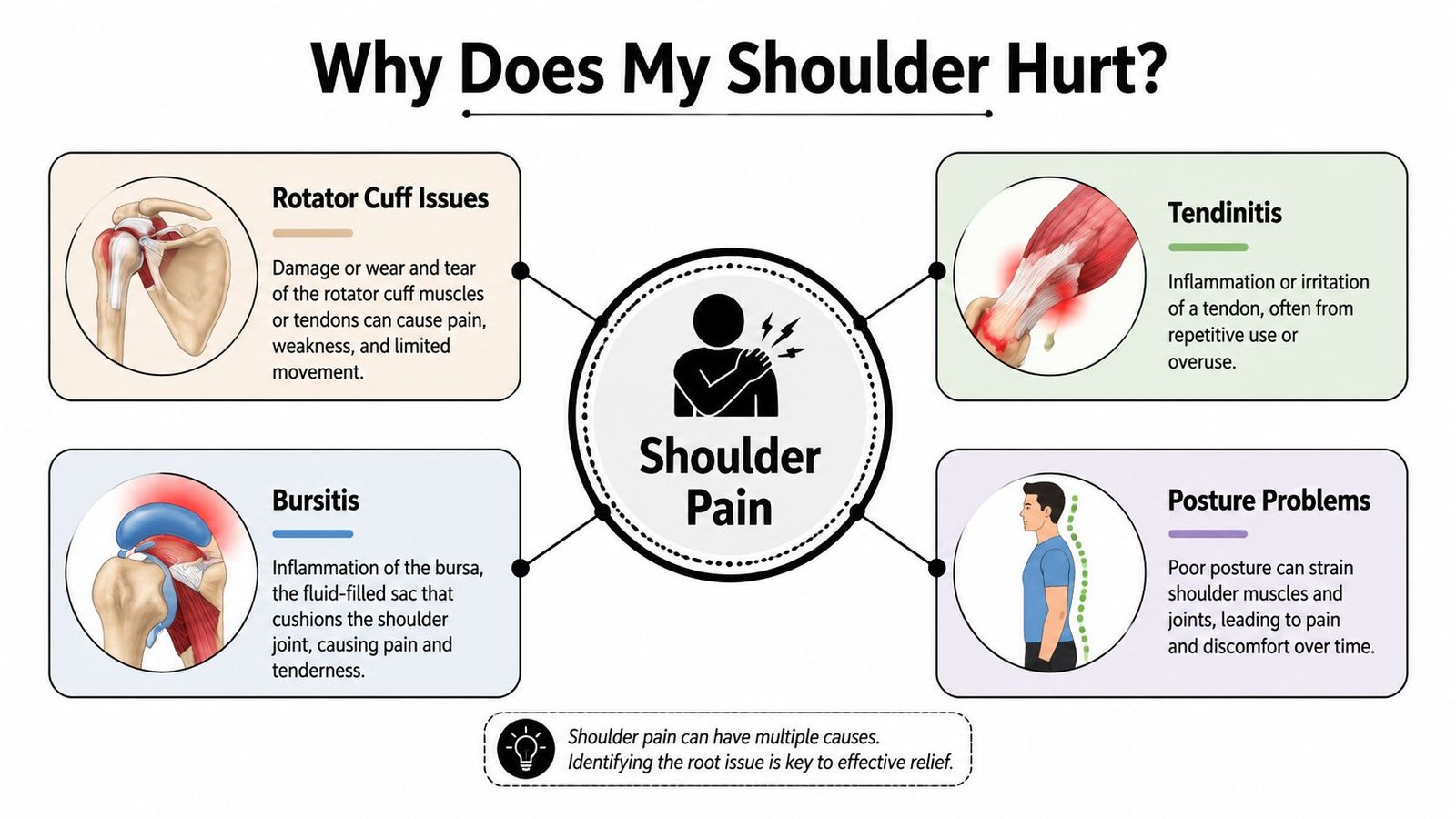
If you'd like a deeper anatomical explanation, this guide on understanding shoulder muscles and tendons is useful background before an assessment.
Common causes of shoulder pain
A label can be helpful, but what matters more is understanding the pattern. Here are some of the problems people commonly present with:
| Condition | Simple Description | What It Might Feel Like |
|---|---|---|
| Rotator cuff irritation | The tendons or muscles that stabilise the shoulder become overloaded or sensitive | Pain when reaching overhead, lifting away from the body, or lying on that side |
| Tendinitis or tendinopathy | A tendon becomes irritated through repeated strain or poor load tolerance | An ache that builds with activity, often worse after doing too much rather than during it |
| Bursitis | The cushioning tissue around the shoulder becomes inflamed and reactive | Sharp pain on certain movements, tenderness, and difficulty with side-lying |
| Frozen shoulder | The joint capsule becomes stiff and the whole shoulder loses movement | Marked stiffness, pain at the limits of motion, trouble with dressing or reaching behind the back |
| Posture-related overload | The shoulder is working from an inefficient base, often with a stiff upper back or rounded shoulders | Neck and shoulder tension, fatigue at a desk, discomfort after prolonged sitting |
| Referred pain from the neck | The shoulder hurts, but the main driver may be the cervical spine | Pain that travels down the arm, tingling, or symptoms linked to neck movement |
A shoulder can be painful for mechanical reasons, postural reasons, or because another area is referring into it. That's why a hands-on assessment matters more than guessing from the internet.
Two people can have the same diagnosis on paper and need different treatment. One may need to restore movement. Another may need to build strength. A third may need the neck and upper back assessed because the shoulder itself isn't the only issue.
Your First Appointment A Roadmap for Your Visit
A first appointment should feel organised, not rushed. Upon arrival, common concerns include whether something is torn, if a scan is necessary, or if continuing to move has worsened the problem. A proper assessment answers those questions in plain English.

What happens first
The opening conversation matters more than people think. A clinician will usually ask when the pain started, whether it came on gradually or after a clear incident, what movements trigger it, whether it affects sleep, and what you need your shoulder to do in real life.
That last point is important. The treatment plan for someone who wants to return to swimming isn't the same as the plan for someone who needs to work at a laptop comfortably or lift a child without hesitation.
If you already know you want an assessment, you can book a shoulder appointment online and get the process moving quickly.
The physical assessment
The assessment usually includes:
Observation of movement. You may be asked to lift the arm forward, out to the side, and behind your back.
Testing range of motion. This shows whether the problem is mainly pain, stiffness, or both.
Strength checks. These help identify whether the rotator cuff and shoulder blade muscles are coping well.
Palpation and joint testing. Gentle hands-on examination can identify tender structures and areas of stiffness.
Screening nearby areas. The neck, upper back, ribs, and posture often contribute to shoulder symptoms.
A good clinician isn't trying to catch you out with painful tests. The aim is to understand what reproduces your symptoms, what eases them, and what the shoulder can tolerate today.
What you should leave with
You should leave the first visit with three things:
A working diagnosis in language you can understand
A clear early plan for pain relief and safe movement
Specific advice on what to keep doing, what to modify, and what to avoid for now
If you leave without understanding why your shoulder hurts and what the next step is, the explanation wasn't clear enough.
Sometimes the answer is straightforward. Sometimes it isn't. But even in more stubborn cases, an experienced clinician can usually identify the main driver and start treatment without unnecessary drama.
The Pillars of Shoulder Pain Treatment
A useful treatment plan has to match the stage of the problem. Very irritable shoulders need a different starting point from long-standing stiff or weak shoulders. But certain principles keep showing up in effective physiotherapy for shoulder pain.
For persistent shoulder pain, the strongest evidence supports targeted shoulder-specific exercise therapy. A systematic review and network meta-analysis found that this approach reduced pain by about 2.1 points on a 0 to 10 pain scale compared with usual medical care, with benefits lasting up to 52 weeks after an average 7.09-week programme (systematic review of exercise therapy for chronic shoulder pain).
Manual therapy
Hands-on treatment can be helpful, but it needs to be used for the right reason. Soft tissue work, gentle mobilisation of the shoulder or upper back, and movement-based manual techniques can reduce guarding and improve the quality of movement.
The important trade-off is this. Manual therapy can make the shoulder feel easier to use, but on its own it usually doesn't build lasting load tolerance. It's most valuable when it creates a window for better exercise, better movement, and better function.
For some rotator cuff and subacromial presentations, evidence supports exercise combined with mobilisation rather than exercise alone, while passive treatments shouldn't be used as stand-alone care (evidence review of physiotherapy interventions for shoulder pain).
Exercise prescription
This is the cornerstone. Not generic shoulder circles. Not random resistance band drills copied from social media. A useful programme targets the reason your shoulder is struggling.
That often means work for:
Rotator cuff strength so the shoulder is better centred during movement
Scapular control so the shoulder blade gives the arm a stable base
Range of motion so stiffness doesn't force compensation elsewhere
Gradual loading so the tissues become more resilient instead of more protected
People often ask whether exercise should hurt. Mild discomfort during rehabilitation isn't automatically a problem, but sharp worsening pain, prolonged flare-ups, or increasing night pain usually mean the dose is wrong.
The best shoulder exercises are the ones you can repeat consistently, progress gradually, and recover from well.
Posture and ergonomics
Posture isn't the whole story, but it can influence shoulder load more than people realise. Desk workers often sit with the upper back stiff, the ribs dropped, and the shoulders drifting forward. That position can make overhead movement harder and can increase strain through the neck and shoulder muscles.
Ergonomic advice only works when it's practical. A few adjustments tend to help more than perfectionism:
Screen position should stop you poking the chin forward all day
Arm support can reduce constant tension through the upper trapezius
Regular movement breaks stop the shoulder stiffening in one posture
Task variation matters if your work includes repeated reaching or lifting
The goal isn't to sit like a statue. The goal is to stop accumulating the same low-grade strain hour after hour.
Medical acupuncture and trigger point therapy
An osteopathic perspective can provide valuable insights. Some shoulder problems involve not only the joint and tendons, but also highly reactive muscle bands through the rotator cuff, deltoid, pectoral region, or upper trapezius.
Medical acupuncture and trigger point therapy can help when muscle guarding is dominating the picture. Used well, they may reduce pain, settle stubborn trigger points, and allow freer movement. They aren't a replacement for strengthening. They're often a way to make strengthening possible.
That's the recurring theme in good shoulder care. Useful symptom relief is welcome, but it has to feed into active rehabilitation. If treatment feels good for a day and changes nothing about your movement or capacity, it isn't enough.
Safe and Effective Shoulder Exercises to Start Today
Most painful shoulders respond better to gentle, well-chosen movement than to total rest. The key is to start below your flare-up threshold and build from there. If an exercise causes a sharp increase in pain or leaves the shoulder clearly worse later that day or the next morning, reduce the range or stop and get it checked.
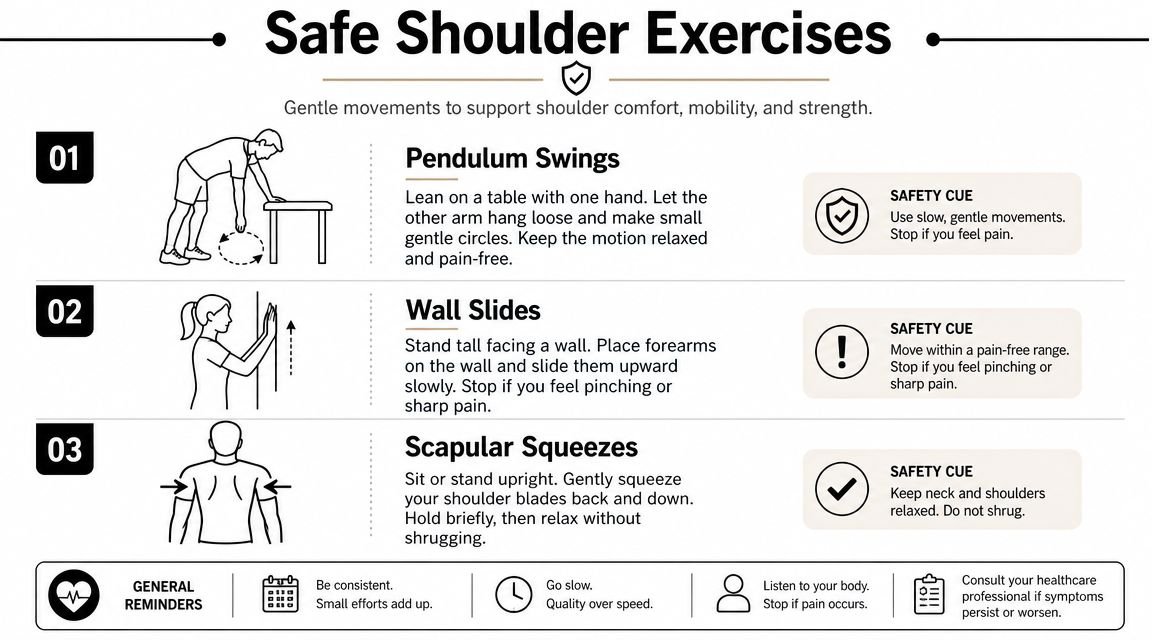
UK clinical guidance consistently places exercise-led treatment at the centre of conservative care for shoulder pain, and evidence summaries note that physiotherapy can be as effective as joint injections or surgery for many common presentations (UK-oriented evidence summary on shoulder pain epidemiology and conservative management).
Pendulum swings
This is often a good starting exercise when the shoulder is irritable.
Lean forward with one hand supported on a table or chair.
Let the sore arm hang relaxed toward the floor.
Use your body to create small forward-backward swings, side-to-side swings, or gentle circles.
Keep the shoulder relaxed. The movement should feel easy, not forced.
Why it helps: it encourages motion without asking the shoulder muscles to work hard.
Wall slides
This is useful when you want to restore comfortable overhead movement.
Stand facing a wall with both forearms or hands resting lightly on it.
Slide the arms upward as far as feels smooth and controlled.
Pause briefly, then return slowly.
Stay out of a painful shrug. Think of the shoulder blade moving upward and outward naturally.
Why it helps: it promotes upward rotation and a cleaner movement pattern with less strain.
A guided visual can help if you prefer to follow movement demonstrations:
Scapular squeezes
This one is simple, but form matters.
Sit or stand tall without arching the lower back.
Gently draw the shoulder blades back and slightly down.
Hold briefly, then relax.
Keep the neck soft. Don't jam the shoulders downward.
Why it helps: it wakes up the muscles that support shoulder blade position and can reduce the sense of collapse through the upper body.
Doorway stretch
This can help if the front of the chest feels tight.
Stand in a doorway with the forearm resting on the frame.
Step through slightly until you feel a stretch across the chest or front of the shoulder.
Hold gently, then come out of the stretch.
Avoid forcing it if the front of the shoulder feels pinchy.
Why it helps: it can reduce stiffness through the chest and make it easier for the shoulder blade to move well.
For more guided movement options, the exercise video library is a practical place to start.
A good home programme should feel manageable. It's better to do a small amount consistently than too much on day one and spend the next two days aggravated.
Your Recovery Journey Timelines and Red Flags
People often want a neat answer to “How long will this take?” The honest answer is that shoulder recovery is a process, not a switch. Some shoulders settle quickly once they start moving well again. Others improve in stages, especially if pain, stiffness, weakness, and work demands have been building for a while.
What recovery usually feels like
A useful way to think about progress is in phases rather than exact deadlines.
Early phase involves calming symptoms, reducing night pain, and restoring confidence in simple movements.
Middle phase focuses on range of motion, rotator cuff work, and better shoulder blade control.
Later phase is about load tolerance. Lifting, carrying, sport, gym work, and repetitive tasks need to be rebuilt, not assumed.
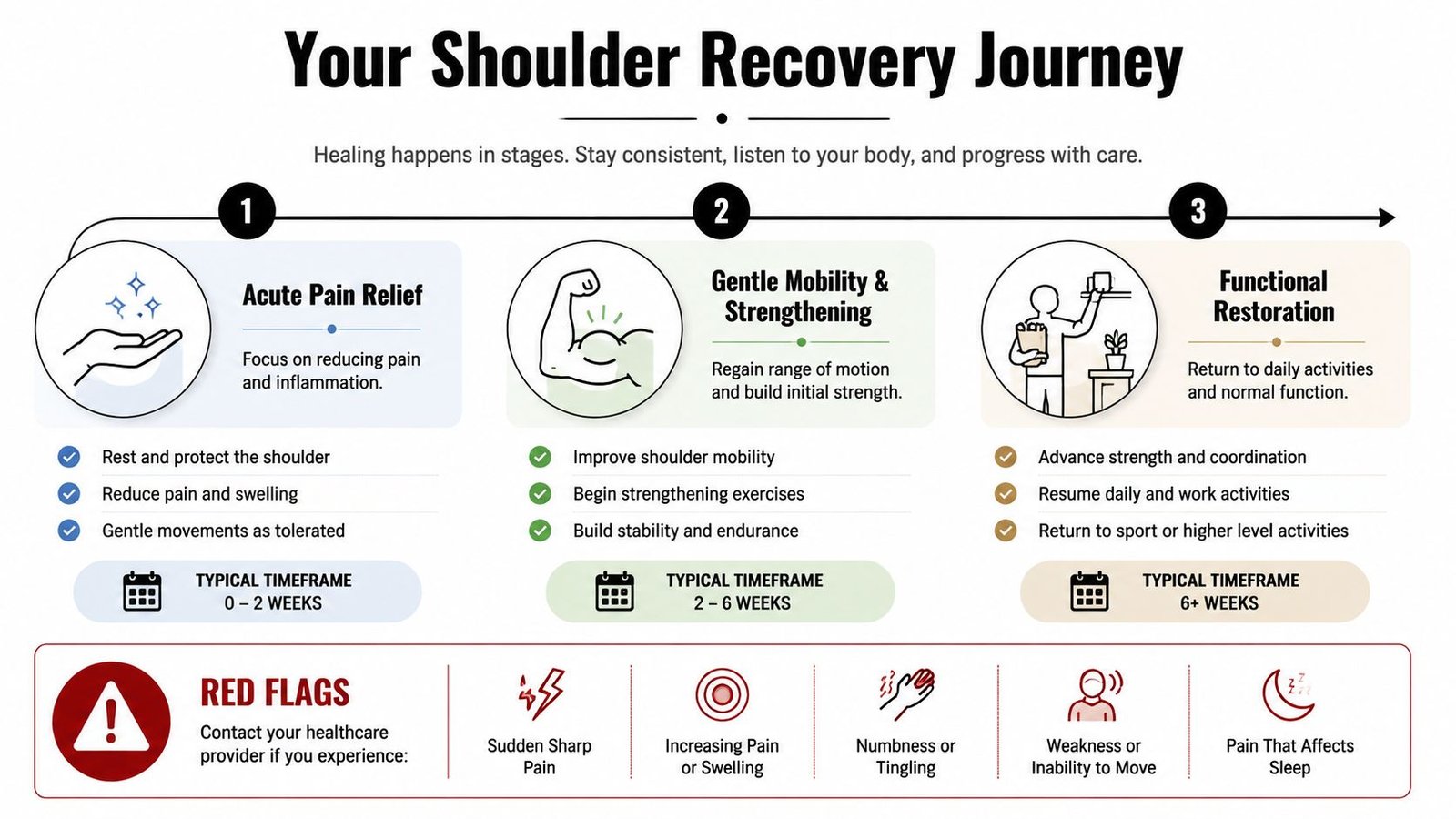
Progress is rarely linear. A shoulder may feel better for several days, then grumble after gardening, decorating, swimming, or a long desk session. That doesn't always mean damage. It often means the shoulder has been asked to do more than it can currently tolerate.
Recovery usually improves when the shoulder is loaded consistently and sensibly, not when activity jumps from too little to too much.
Red flags
Some symptoms need medical review promptly rather than routine therapy alone.
Seek urgent advice from a GP or A&E if you have:
Sudden severe pain after trauma and you can't lift the arm
Visible deformity or suspicion of dislocation
New numbness, marked weakness, or loss of sensation in the arm or hand
Signs of infection, such as fever, redness, heat, or feeling unwell with severe shoulder pain
Unexplained persistent pain at rest that doesn't change with position or movement
Chest pain or breathlessness with left shoulder pain
These situations don't automatically mean something serious is happening, but they do need proper medical assessment.
Choosing Your Clinic in Highgate or Woking
If you're looking for help locally, choose a clinic that does three things well. It should assess properly, explain clearly, and treat actively. That means you understand what's likely going on, why the treatment is being used, and what you need to do between sessions.
Experience matters, especially with shoulders that haven't responded elsewhere. The shoulder is influenced by the neck, ribs, thoracic spine, posture, sport, work habits, and previous injuries. A good practitioner won't look only at the sore spot. They'll work out why the shoulder became overloaded in the first place.
It also helps to choose a clinic that can combine different approaches without losing the main goal. Hands-on osteopathy, exercise rehabilitation, trigger point work, and medical acupuncture can work very well together when they're used to support movement and function rather than as isolated fixes.
For readers in North London, the Highgate osteopathy clinic is one local option if you want a hands-on assessment with a practitioner experienced in shoulder, neck, and upper back problems.
The best next step is simple. If your shoulder has been painful for more than a short flare-up, if it's affecting sleep or daily tasks, or if you've stopped trusting it, get it examined properly. A clear diagnosis and a structured rehabilitation plan usually save a great deal of time and frustration.
If your shoulder pain is stopping you from sleeping comfortably, working normally, or returning to sport, Laurens Holve Healthcare offers hands-on osteopathy, medical acupuncture, and practical rehabilitation from clinics in Highgate and Woking. Laurens Holve has over 35 years in practice and has delivered more than 30,000 successful treatments, with a strong focus on helping people who want a clear, drug-free path back to normal movement. You can book online, access practical exercise support, and get a thorough assessment that looks beyond the shoulder itself to the wider cause of the problem.